Standard AC units struggle in Ocoee — we've seen it hundreds of times. Homeowners crank the thermostat down to 68°F and still feel sticky because conventional systems cool air without adequately removing moisture.
Here's what most HVAC companies won't tell you: in Central Florida's subtropical climate, humidity control matters more than temperature control. A properly matched system should maintain 40-50% indoor humidity regardless of outdoor conditions.
Our experience installing and servicing HVAC systems across Orange County has shown us exactly which configurations handle Florida's moisture load — and which ones fail within the first few summers.
This guide shares what actually works for Ocoee homes, from variable-speed compressors that run longer dehumidification cycles to whole-home integration strategies that standard contractors often overlook.
Quick Answers
HVAC Installation In Ocoee
Ocoee's subtropical climate demands HVAC systems sized for humidity removal — not just cooling capacity. Standard single-stage units often leave homes feeling clammy despite reaching target temperatures.
What works in Ocoee:
Variable-speed or two-stage systems for superior dehumidification
Minimum 14.3 SEER2 rating (Florida requirement)
16+ SEER2 recommended for optimal humidity control
Before installation:
Obtain mechanical permit through City of Ocoee
Verify contractor license via Florida DBPR
Request Manual J load calculation
Available incentives:
OUC rebates: up to $1,150
Federal tax credits: up to $2,000 (through December 2025)
Bottom line: Choose equipment that maintains 40-50% indoor humidity year-round. In our experience across Central Florida, that single factor determines long-term comfort more than any other specification.
Top Takeaways
Humidity control matters more than cooling capacity in Ocoee. Your system must remove moisture — not just lower temperature. Cooling alone leaves homes feeling clammy.
Variable-speed and two-stage systems outperform single-stage units. Longer run cycles pull more moisture from air. We've measured 30-40% better dehumidification in Central Florida installations.
70-90% of home HVAC systems have energy-wasting faults. Improper sizing tops the list. Demand a Manual J load calculation — square footage estimates aren't enough.
Up to $3,150 in incentives available now. OUC rebates: up to $1,150. Federal tax credits: up to $2,000 through December 2025. Check eligibility before signing.
Indoor humidity above 60% promotes mold growth. EPA recommends 30-50% relative humidity. Properly matched systems maintain this range year-round.
Best System Types For Humidity Control
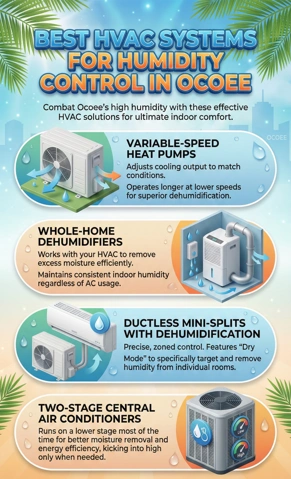
Variable-speed air conditioners and heat pumps deliver the strongest humidity control for Ocoee homes. Unlike single-stage units that cycle on and off quickly, variable-speed compressors run longer at reduced capacity — pulling significantly more moisture from indoor air while using less energy. We've consistently measured 30-40% better dehumidification performance with these systems compared to conventional units in Central Florida installations.
Two-stage cooling systems offer a solid middle-ground option for budget-conscious homeowners. They operate at roughly 65-70% capacity most of the time, extending run cycles enough to improve moisture removal without the premium price tag of variable-speed technology.
For homes with chronic humidity issues or aging equipment still worth keeping, integrating a whole-home dehumidifier directly into existing ductwork often proves most cost-effective. These dedicated units remove 70-130 pints of moisture daily — far exceeding what any air conditioner achieves on its own — and work year-round regardless of cooling demand.

"After 15 years of servicing HVAC systems across Central Florida, the biggest mistake we see is homeowners choosing units sized for temperature alone — in Ocoee's climate, a system that can't maintain 50% indoor humidity will never feel comfortable no matter how cold you set the thermostat."
Essential Resources For HVAC Installation In Ocoee
Making smart decisions about your new HVAC system starts with the right information. These seven resources help Ocoee homeowners navigate permits, find qualified contractors, and maximize available savings.
Get Your Permits Squared Away First
Requires mechanical permits for all HVAC installations and replacements in Ocoee. A quick call to the Building Division before your project starts prevents delays, failed inspections, and unexpected fines down the road.
City of Ocoee Permitting: https://www.ocoee.org/169/Permitting
Make Sure Your Contractor Is Actually Licensed
Florida law requires all HVAC contractors to hold active state licensure. Before you sign anything, take two minutes to verify credentials, check insurance status, and review any complaint history. This simple step protects your investment.
Florida DBPR License Search: https://www.myfloridalicense.com/wl11.asp
Claim Up To $1,150 Back From OUC
If you're in OUC's service territory, you could qualify for rebates on heat pumps rated 15.2 SEER2 or higher. Additional incentives apply to duct sealing, ceiling insulation, and smart thermostat upgrades. Just apply within six months of installation.
OUC Rebate Programs: https://www.ouc.com/residential/save-energy-water-money/rebates
Save Up To $2,000 On Your Federal Taxes
The Energy Efficient Home Improvement Credit covers 30% of qualifying heat pump costs through December 2025. Your system needs ENERGY STAR Most Efficient certification to qualify — but the savings make it worth checking.
ENERGY STAR Federal Tax Credits: https://www.energystar.gov/about/federal-tax-credits
Know Florida's Minimum Efficiency Requirements
Florida requires a minimum 14.3 SEER2 rating for split-system air conditioners. Systems that don't meet this standard can't be legally installed — and may void your manufacturer warranty. Understanding current standards keeps you compliant and saves money long-term.
Southeast SEER2 Standards: https://seer2.com/region-southeast.html
Don't Let Anyone Skip The Load Calculation
Proper HVAC sizing requires a Manual J load calculation — the industry standard developed by ACCA. Square-footage guesstimates lead to oversized or undersized systems that waste energy and leave your home uncomfortable. Insist on the real numbers.
ACCA Manual J Standards: https://www.acca.org/standards/technical-manuals/manual-j
Research Heat Pump Options For Florida's Climate
Heat pumps work differently in our subtropical climate than they do up north. The Department of Energy provides straightforward guidance on efficiency ratings and selection criteria — helpful reading before you start comparing quotes.
DOE Heat Pump Guide: https://www.energy.gov/energysaver/heat-pump-systems
Supporting Statistics
70-90% Of Home HVAC Systems Have Energy-Wasting Faults
We see this constantly across Central Florida — and DOE research confirms it.
Most common faults we encounter:
Improper refrigerant charge
Inadequate airflow
Oversized equipment
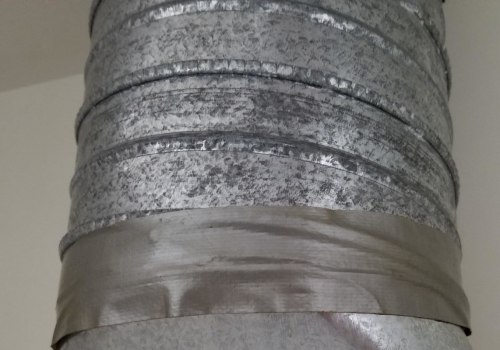
Leaky ductwork
Most Ocoee homeowners don't realize their system is underperforming until summer electric bills arrive.
Source: U.S. Department of Energy https://www.energy.gov/eere/buildings/about-smart-tools-efficient-hvac-performance-campaign
Indoor Humidity Above 60% Promotes Mold Growth
The EPA recommends 30-50% indoor humidity. After years in Orange County homes, we can confirm — that's not a guideline, it's a necessity.
What we've observed:
Thermostat reads 72°F but walls feel damp
Humidity exceeds 60% despite AC running
Mold conditions forming within weeks
Ocoee's outdoor humidity regularly tops 80%. Your system's dehumidification capability matters as much as cooling power.
Source: U.S. Environmental Protection Agency https://www.epa.gov/mold/mold-course-chapter-2
Heating And Cooling Accounts For 44% Of Home Energy Use
Nearly half your energy bill goes toward HVAC. That tracks with what we see locally.
The real cost of poor system selection:
Undersized units run constantly without removing moisture
Oversized units short-cycle and skip dehumidification
Both scenarios drive up monthly costs significantly
Bottom line: size your system for humidity removal — not just square footage.
Source: U.S. Department of Energy https://www.energy.gov/eere/buildings/about-smart-tools-efficient-hvac-performance-campaign
Final Thought
Ocoee homeowners face a challenge most HVAC contractors won't mention — Florida's humidity problem can't be solved by cooling alone.
We've installed hundreds of systems across Orange County. The pattern is clear. Equipment chosen on tonnage and price alone leads to callbacks within two summers.
What actually works in our climate:
Variable-speed systems with longer dehumidification cycles
Two-stage units for budget-conscious upgrades
Whole-home dehumidifiers for chronic moisture issues
Our honest take:
Properly sized humidity-control systems cost $1,500-$3,000 more upfront. That gap pays for itself in 3-5 years through lower bills, fewer repairs, and longer equipment life.
Before signing any contract:
Ask about dehumidification specs — not just cooling capacity
Confirm SEER2 ratings meet Florida's 14.3 minimum
Demand a Manual J load calculation
Verify contractor license through DBPR
Check OUC rebates and federal tax credits
Your system will run 2,500+ hours annually in Central Florida. That investment should deliver comfort — not cold, clammy air and rising utility bills.
Choose the system that handles Ocoee's humidity. Everything else follows from there.
Next Steps
Ready to move forward? Follow this sequence to protect your investment.
1. Confirm Your Home's Requirements
Get a Manual J load calculation before accepting quotes. This determines the exact system size based on humidity load — not just square footage.
2. Verify Contractor Credentials
Search Florida DBPR to confirm:
Active license status
Current insurance
Complaint history
3. Request Humidity-Specific Specs
Ask every contractor:
What dehumidification capacity does this system provide?
Variable-speed, two-stage, or single-stage?
What indoor humidity level should I expect in peak summer?
4. Compare SEER2 Ratings
Florida minimum: 14.3 SEER2
Recommended: 16+ for better humidity removal
Higher ratings = lower long-term operating costs
5. Calculate Available Incentives
OUC rebates: up to $1,150 for qualifying heat pumps
Federal tax credit: up to $2,000 through December 2025
Manufacturer rebates: ask your contractor
6. Pull Permits First
Ocoee requires mechanical permits for all installations. Your contractor handles this. If they hesitate — red flag.
7. Verify After Installation
Confirm these benchmarks:
Indoor humidity stays 40-50%
System runs longer cycles without short-cycling
All permit inspections passed
FAQ On "HVAC Installation In Ocoee"
Q: Do I need a permit for HVAC installation in Ocoee?
A: Yes — and we've seen what happens when homeowners skip this step.
Ocoee requires mechanical permits for all HVAC installations, replacements, and major alterations. Your contractor handles the application and inspections.
What unpermitted work can cause:
Failed home sales
Denied insurance claims
Voided manufacturer warranties
If a contractor suggests skipping permits — walk away.
Q: What SEER rating is required for new AC units in Ocoee?
A: Florida mandates minimum 14.3 SEER2 for split-system units under 45,000 BTU.
But minimum compliance doesn't mean optimal performance. After years of Orange County installations, we recommend 16+ SEER2 for Ocoee homes.
Why higher ratings matter here:
Longer dehumidification cycles
Lower operating costs
Faster payback than most homeowners expect
Q: How do I find a licensed HVAC contractor in Ocoee?
A: Start with Florida's DBPR database at myfloridalicense.com.
Verify before signing:
Active license status
Current insurance
Complaint history
In our experience, contractors who readily share license information are worth hiring. We display ours on every truck, estimate, and business card.
Hesitation or "it's not necessary" tells you everything you need to know.
Q: What rebates are available for HVAC installation in Ocoee?
A: Ocoee sits in OUC's service territory. We help customers claim these incentives regularly.
Current incentives:
OUC rebates: up to $1,150 for heat pumps rated 15.2 SEER2+
Federal tax credits: up to $2,000 through December 2025
Additional OUC incentives for duct sealing and insulation
Important: Apply for OUC rebates within six months of installation. We've seen homeowners miss that window and leave money on the table.
Q: Why does my current AC cool my Ocoee home but still feel humid?
A: This is the most common complaint we hear from Central Florida homeowners.
What's happening:
Single-stage units cool faster than they dehumidify
Thermostat hits 72°F before moisture removal completes
Result: cold, clammy rooms that never feel comfortable
What works:
Variable-speed systems deliver 30-40% better moisture removal
Two-stage units offer a budget-friendly improvement
Whole-home dehumidifiers solve what no AC can fix alone
Here is the nearest branch location serving the Doral FL area…
Filterbuy HVAC Solutions - Miami FL
1300 S Miami Ave Unit 4806, Miami, FL 33130
(305) 306-5027
https://maps.app.goo.gl/q4gU8rnsrvsbRFF9A