Pull a year-old five-inch filter out of its cabinet and you can see what your family stopped breathing: a gray mat of dust, pet hair, and pollen pressed deep into the pleats. That gray mat is the quiet protection an FLR06070 gives you between changes. Seating a fresh one takes me about five minutes once I know the cabinet and the arrow, and this deep-pleated air filter slides into a dedicated housing rather than a thin return slot, so the routine differs a little from the one-inch panels most of us grew up swapping. I keep a few American Standard 21x27x5 air filters FLR06070 on the shelf for this exact job. Let me walk you through it, step by step, so your system breathes clean and runs easy.
TL;DR Quick Answers
- Turn the system off.
- Open the media cabinet on the return side of the air handler or furnace. Sealed ductwork helps keep airflow strong once the filter is back in.
- Slide out the old filter and note its arrow direction.
- Slide in the FLR06070 with the arrow pointing toward the blower so it can trap more airborne dust.
- Latch the cabinet door so air cannot bypass the filter.
- Turn the system back on, and plan the next change in about three months.
Top Takeaways
- The FLR06070 is a five-inch deep-pleated filter, nominal 21x27x5, that seats in a media cabinet on the return side of your air handler or furnace.
- It cross-references the Trane Perfect Fit BAYFTFR21M and comes in MERV 8, 11, and 13, so picking the right filter comes down to how much filtration your system can handle.
- The airflow arrow points toward the blower and away from the return.
- A latched, sealed cabinet door matters as much as the filter itself.
- Plan on a replacement about every three months for reliable seasonal filtration, and check it monthly.
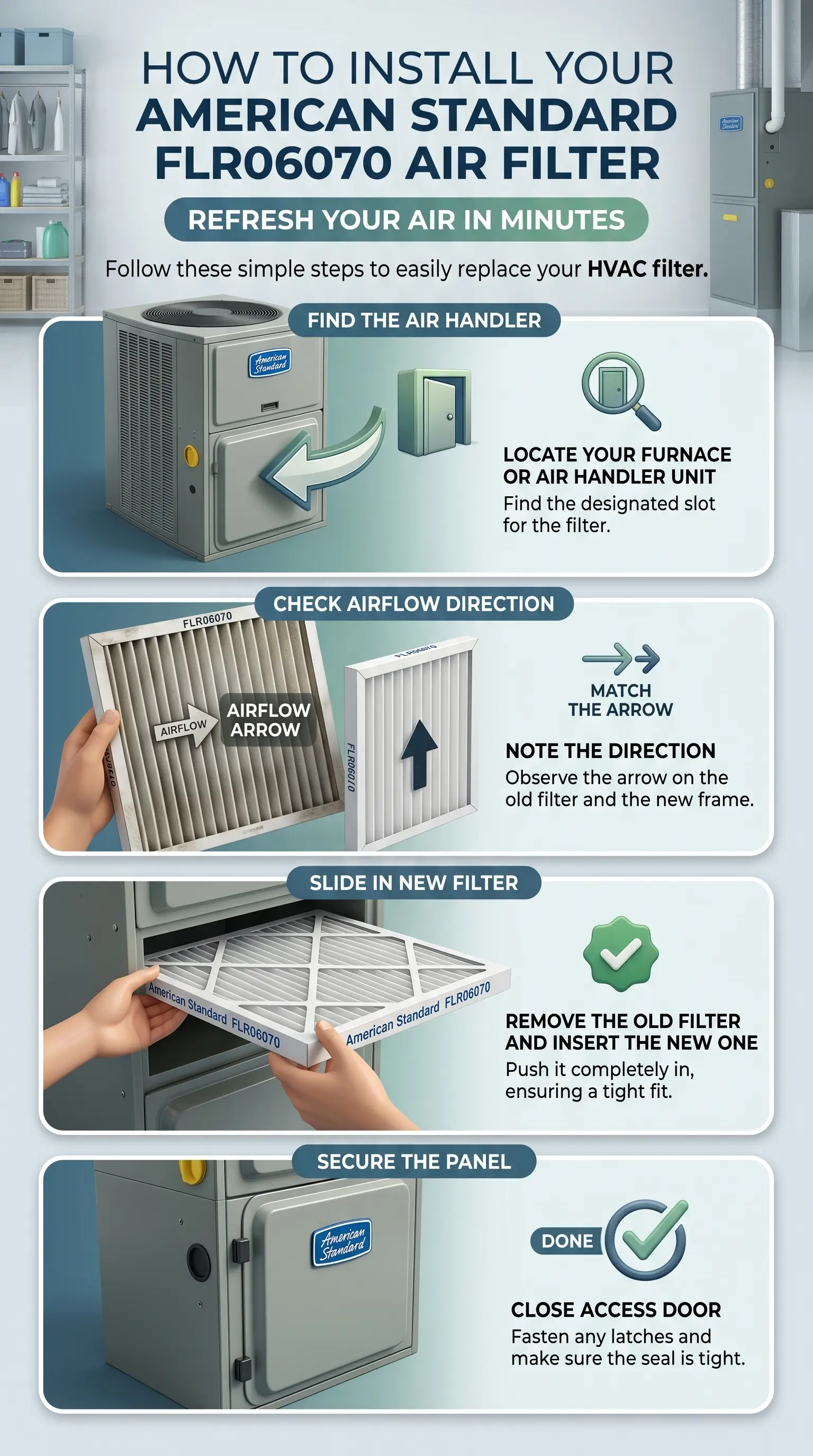
Here is the routine I run on every five-inch cabinet filter. It is the kind that gives me deeper pleated filtration than a thin panel, and that extra depth is exactly why a careful install pays off.
- Turn the system off at the thermostat. I set the fan to off so the blower is not pulling air while the cabinet sits open.
- Find the media cabinet. On most homes it is a boxy metal housing on the return side of the furnace or air handler, fronted by a hinged or slide-out door. The FLR06070 lives there, not behind a wall or ceiling grille.
- Open the door and slide the old filter out. Before you toss it, check the airflow arrow on the frame and note which way it pointed.
- Check the new filter against the old one. The FLR06070 is a nominal 21x27x5, with an actual size close to 20.7 by 26.2 by 5 inches, and it cross-references the Trane Perfect Fit BAYFTFR21M. If either marking matches, you have the right filter.
- Slide the new filter in with the arrow pointing toward the blower. Air travels from your rooms, through the return, across the filter, and into the equipment, so a clean panel can capture everyday dust before it ever reaches the coil.
- Close and latch the cabinet door. A door that does not seal lets a ribbon of air slip around the filter instead of through it, and that small gap quietly undercuts how well the filter can defend against household dust.
- Turn the system back on and listen. Steady, even airflow means you are done.

“The detail people overlook is the cabinet door. If it does not latch flush, a slice of return air slides right past a filter that is otherwise doing its job”
When a swap turns up something deeper than a dirty filter, I would rather bring in professional HVAC help than keep guessing.
Resources I Trust for Filters and Air Quality
- Guide to Air Cleaners in the Home (EPA): how to pick a MERV rating your system can handle and why the filter slot size matters.
- Air Conditioner Maintenance (U.S. Department of Energy): where filters sit on the return side and how regular changes protect the system.
- Air Cleaning (American Lung Association): plain-language guidance on filter location, MERV choice, and change intervals.
- Improving Air Cleanliness (CDC NIOSH): why a filter that fits its rack tightly matters for the air you breathe.
- Indoor Air Quality (NIEHS): the health case for keeping indoor particle levels down.
- Home HVAC Systems (Ohio State Green Home Technology Center): how forced-air systems and the air handler filter work together.
- Understanding Your Heating System (MSU Extension): how returns, registers, and airflow move through the house.
What a Fresh Filter Actually Does, by the Numbers
- Americans spend about 90% of their time indoors, where some pollutant levels run two to five times higher than outdoors, according to the EPA.
- Replacing a dirty, clogged filter with a clean one can lower an air conditioner's energy use by 5% to 15%, per the U.S. Department of Energy.
- ENERGY STAR-certified homes require filters rated MERV 6 or higher, while the EPA and ASHRAE recommend a minimum of MERV 13 for managing fine particles and viruses, as summarized by the DOE Building America Solution Center.
A Few Opinions I've Earned the Hard Way
- The five-inch media filter is the easiest upgrade I recommend. It holds far more dust than a one-inch panel, so a longer-lasting filtration setup means fewer changes and cleaner returns between them.
- Buy the replacement before you pull the old one. A filter that can reduce airborne allergens does nothing sitting at the store, and a week of running unfiltered sends dust straight to the parts you cannot easily clean.
- Mark the airflow direction on the cabinet with a permanent marker. Future you will thank present you.
- Do not chase the highest MERV your wallet allows before you check the system. A filter your blower cannot pull air through trades clean air for a strained motor, and that is a bad trade.
- A filter is only part of the picture. I schedule a seasonal tune-up so the blower and coil get attention too.
- Clean filters do their best work when the whole home breathes well, so I also keep my dryer vent clear and watch for airflow trouble in other rooms.
Frequently Asked Questions
Which way does the FLR06070 face when I install it?
The arrow on the frame points toward the blower, following the air from your return into the furnace or air handler. Flip it the other way and the filter fights the airflow instead of cleaning it.
What size is the FLR06070, really?
It sells as a nominal 21x27x5, with an actual size close to 20.7 by 26.2 by 5 inches. Buy to the nominal size, then confirm the actual measurement against your old filter.
Will a Trane Perfect Fit BAYFTFR21M fit the same cabinet?
Yes. The FLR06070 and the BAYFTFR21M are cross-referenced for the same 21x27x5 media cabinet, so either marking points you to the right filter.
How often should I replace it?
About every three months in a normal home, and sooner if you have pets, smoke indoors, or are living through a dusty renovation. Pairing fresh filters with clean vents keeps airflow strong between changes.
Can I run my system while the filter is out?
Only for the minute it takes to swap. Run it longer and dust heads straight for the blower and coil, so if something already sounds off, a local repair estimate beats pushing the system harder.
What MERV rating should I choose?
Use the highest rating your system can pull air through without strain. For most homes, MERV 8 through 13 balances cleaner air with steady airflow, and a reusable filter option suits households that would rather wash and reinstall.
Set Up Your Next FLR06070 Swap for an Easy Fit
Knowing the size, the arrow, and the cabinet turns a dreaded chore into a five-minute habit that protects your family's air and your equipment. Keep spare filters ready and your next change becomes the easiest thing you do all month.
Learn more about HVAC Care from one of our HVAC solutions branches…
Filterbuy HVAC Solutions - Miami FL - Air Conditioning Service
1300 S Miami Ave Apt 4806 Miami FL 33130
(305) 306-5027
https://maps.app.goo.gl/Ci1vrL596LhvXKU79