16x21.5x4 Air Filters: Your Simple Seasonal Checklist
I've pulled 16x21.5x4 filters that looked barely used right up until the airflow told a different story. That's the trap with this deeper size: it hides dirt longer than a thin filter, so “just look at it” stops being reliable advice. This page skips the generic filter tips and gives you the season-by-season checklist I actually use to stay ahead of it.
TL;DR Quick Answers
A 16x21.5x4 filter is a deeper-media filter, so it holds more dust than a standard 1-inch filter and doesn't need to be changed as often. I still check mine every month and replace it on a seasonal rhythm, roughly every 60 to 90 days, adjusting sooner if I have pets, allergies, or heavy HVAC use. This checklist walks through what to do each season so the filter never gets ahead of you.
Top Takeaways
Check a 16x21.5x4 filter monthly, but expect to replace it every 60 to 90 days depending on household conditions.
A dirty filter forces your system to work harder, increasing energy costs and shortening equipment life.
Seasonal transitions (spring and fall) are the easiest time to build a filter-check habit, since they line up with pre-season HVAC tune-ups
Holding a filter up to a light source is the fastest check I've found for judging whether it's still doing its job
Deeper 4-inch filters like the 16x21.5x4 last longer than 1-inch filters but still need a real schedule, not “out of sight, out of mind”
Why the 16x21.5x4 Size Behaves Differently
A 16x21.5x4 filter is a four-inch media filter, not a standard one-inch filter. The extra depth gives it more surface area, which means it can hold more dust before airflow starts to suffer. That's the upside. The downside is that a deeper filter is easy to forget about precisely because it doesn't look dirty as quickly as a thin one does.
I treat mine on a seasonal cycle instead of waiting for a visible warning sign. That habit has saved me from a few sluggish system days, especially heading into a Florida summer when the AC barely gets a break.
What Most Filter Guides Skip About This Size
A few things about this specific filter trip people up more than the seasonal schedule does, and I don't see them explained very often:
It usually lives in a media cabinet, not a slot. A 4-inch filter like the 16x21.5x4 is almost always housed in a side-mounted cabinet with a latch or a few screws, not the slim return-grille slot a standard 1-inch filter uses. If you've only ever changed a thin filter before, this is the first thing to relearn, and it's the reason some homeowners think they don't have a filter to check at all.
The airflow arrow matters more on a deep filter. Installing a 4-inch filter backward is an easy mistake to make and a hard one to catch visually once the cabinet door is closed. I trace the arrow with my finger before I close it up, every time, because a backward filter can look perfectly fine while quietly doing almost nothing.
Nominal size isn't cabinet size. The 16x21.5x4 printed on the box is a rounded, shopping-friendly number, not the exact opening it fits into. Before you order a replacement, measure your actual cabinet opening once and write it down, so you're not guessing every time you reorder.
No visible dirt doesn't mean clean airflow. This is the mistake I see most often with this size: judging a deep filter by whether it looks dirty instead of checking airflow at the vents, which shows up as a warning sign well before the filter looks obviously loaded.
The Seasonal Checklist
Spring (pre-cooling season)
I inspect the filter before the first real heat wave, every year, no exceptions. I hold it up to a window or a bright light: if I can still see light coming through evenly, it has some life left. If it looks gray, matted, or the light barely gets through, I replace it now, not after the season is already underway.
Summer (peak cooling season)
This is when the system runs the hardest, so I check monthly even when I'm not planning to replace monthly. I pay close attention to airflow at the vents, because weaker airflow than usual is almost always the first sign a filter is loading up faster than expected.
Fall (pre-heating season)
I swap the filter as part of my fall HVAC check, whether or not it looks visibly dirty. This is also when I revisit my furnace filter change schedule and double-check the filter size is still correct, especially if any HVAC work happened over the summer.
Winter (heating season)
Furnaces pull air through the same air filter slot, so my checklist doesn't stop just because cooling season is over. I check monthly through winter too, and I've learned not to assume a filter is “done for the year” just because it went in back in fall.
Warning Signs You Shouldn't Wait Out
These aren't signs I pulled from a manufacturer's manual. They're the signs of a clogged filter that have actually tipped me off before, and any one of them means it's time to replace the filter regardless of what the calendar says:
Visible gray or brown buildup across the pleats
Noticeably weaker airflow from the vents
Higher-than-usual energy bills with no other explanation
Dust settling faster than normal on nearby surfaces
A musty smell when the system kicks on
If you're shopping for a replacement, I'd point you toward a dedicated 16x21.5x4 air filters page so you're not guessing at sizing when you're standing in a store aisle.
A Practical Note From Experience
I've replaced enough filters in enough houses to know the biggest mistake isn't picking the wrong MERV rating. It's forgetting the filter exists until the system is already struggling. A seasonal reminder, even a simple one on your phone, does more for your HVAC system than any single filter upgrade.
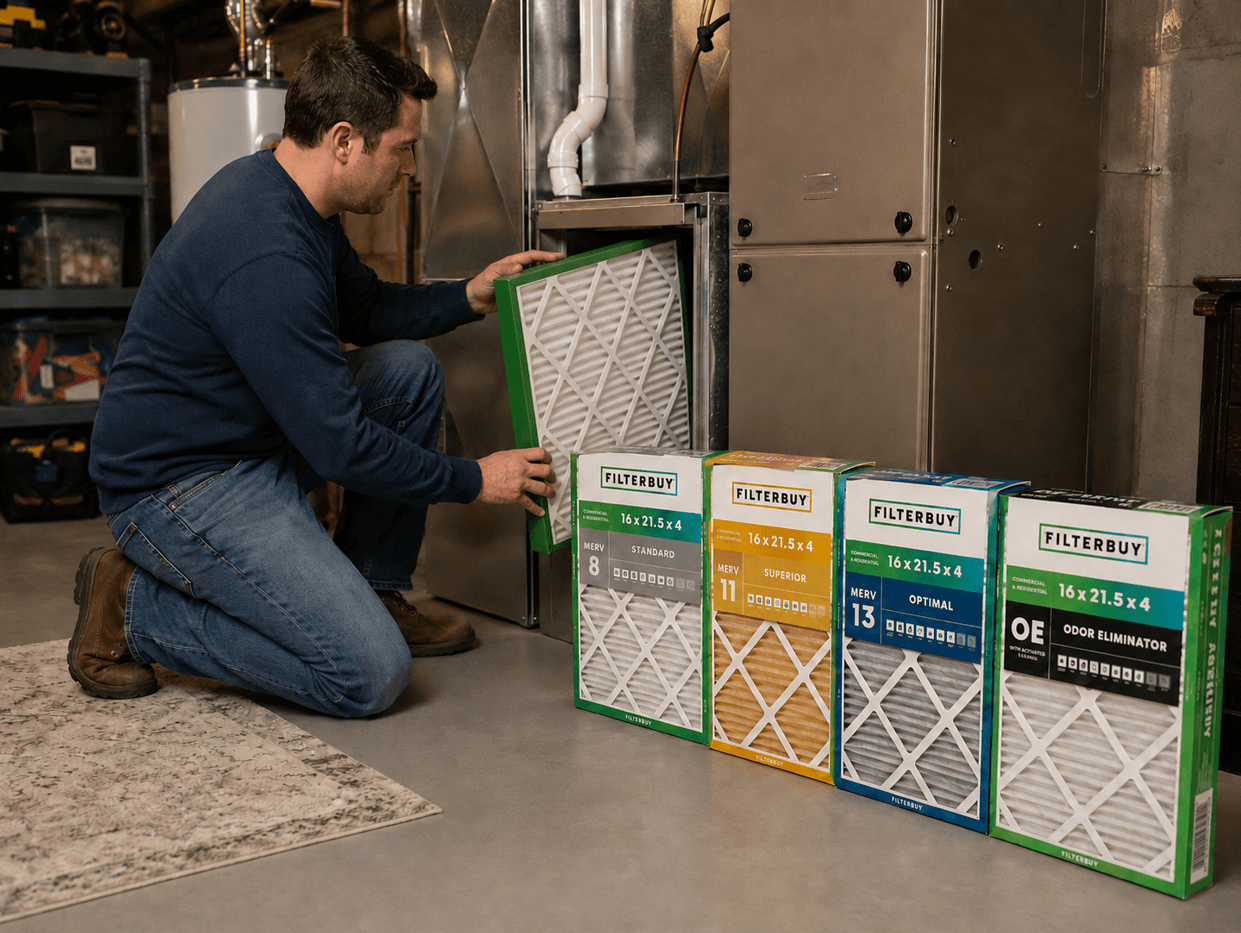
“What I've noticed with these deeper filters is that they never look dirty until the airflow already has, so I stopped trusting my eyes alone and started marking the install date right on the frame. That one habit has caught more overdue filters for me than any seasonal reminder ever did.” - Johnny Gooley
Essential Resources on “16x21.5x4 Air Filters”
Know Exactly When to Check and Replace Your Filter
For a 16x21.5x4 filter, ENERGY STAR's heating and cooling guide sets the baseline: check it monthly and replace it at least every three months, even if it still looks clean. It's the standard this whole seasonal checklist builds from.
Source: ENERGY STAR
Understand Why What's in Your Filter Affects Your Air
The EPA's indoor air quality guide explains why the air moving through your filter matters, especially since most people spend the large majority of their time indoors. It's the clearest starting point for understanding what a clean filter is actually protecting against.
Source: U.S. Environmental Protection Agency
See How Filter Depth Changes Real-World Performance
NAFA's residential air filtration guide breaks down why a deeper filter behaves differently than a standard 1-inch filter, including the airflow limits most homeowners never think about. It's written for homeowners, not just HVAC technicians.
Source: National Air Filtration Association
Calculate the Real Cost of Skipping Filter Maintenance
ACEEE's healthy buildings research ties deferred home maintenance directly to higher energy bills and higher healthcare costs, showing why a neglected filter is rarely just a comfort issue. It's a useful reminder that skipping maintenance has a compounding cost, not just an immediate one.
Source: American Council for an Energy-Efficient Economy
Learn How a Dirty Filter Can Affect Allergy and Asthma Symptoms
The CDC's guide to controlling asthma outlines common indoor triggers, including dust and pet dander, that a well-maintained filter helps keep out of circulation. Useful context if allergies or asthma factor into your filter decision.
Source: Centers for Disease Control and Prevention
Check Whether Your HVAC System Can Handle a Higher-MERV Filter
The Department of Energy's Building America Solution Center explains the tradeoff between filtration efficiency and airflow resistance, including how pleat depth changes that math for a deeper filter like a 16x21.5x4.
Source: DOE / Pacific Northwest National Laboratory
Get an Industry-Level View of How Filters Are Rated and Installed
AHRI's air filtration guide covers filter types, installation standards, and maintenance factors straight from the trade association that helps set residential filter performance standards.
Source: Air-Conditioning, Heating, and Refrigeration Institute
Supporting Statistics
I keep three numbers in mind whenever I explain why a checklist like this actually matters, not just for comfort, but for your wallet and your air:
Space heating and air conditioning account for 52% of a typical U.S. household's annual energy use. A neglected filter isn't a minor maintenance item; it's dragging down the single biggest energy expense most homes have.
Source: U.S. Energy Information Administration
About 8 in 10 people in the U.S. are exposed to dust mites, and 6 in 10 are exposed to pet dander. Those are exactly the particles a 16x21.5x4 filter is built to catch before they recirculate through your vents.
Source: Asthma and Allergy Foundation of America
Nationally, 44% of Americans, over 152 million people, live in places that receive failing grades for ozone or particle pollution. That's outside air your filter has to work harder to keep out, which is part of why I don't treat filter checks as optional in a Florida summer.
Source: American Lung Association
Final Thoughts and Opinion
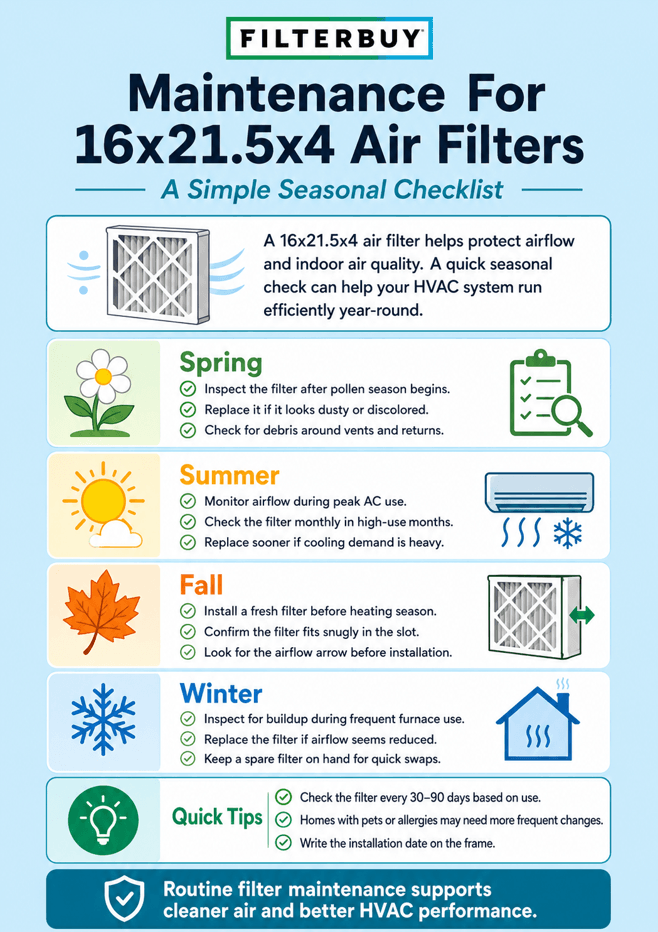
A 16x21.5x4 filter is more forgiving than a thin one, but “more forgiving” isn't the same as “set it and forget it.” Building the check into your seasonal routine- spring, summer, fall, and winter- is the simplest way to protect both your air quality and your energy bill without overthinking it.
Frequently Asked Questions
How often should I really replace a 16x21.5x4 filter?
Most households land between 60 and 90 days. Homes with pets or allergy sufferers often need to check closer to the 30 to 45-day mark.
Can I just clean it instead of replacing it?
Most 4-inch media filters are disposable, not washable. Check the packaging for your specific filter before attempting to clean and reuse it.
Does a dirtier filter really affect my energy bill?
Yes. A clogged filter makes the blower work harder, which increases energy use and adds strain to the system over time.
What happens if I use the wrong size?
A poor fit lets unfiltered air bypass the filter around the edges, which reduces its effectiveness even if the filter itself is brand new.
What happens if I skip a whole season and never check it?
Airflow gets restricted, your energy bill creeps up, and more dust recirculates through the house. In my experience, a fully skipped season is exactly when a 16x21.5x4 filter goes from fine to overdue, since its extra depth hides that decline longer than a thin filter would.
Start Your Seasonal Checklist Today
This seasonal checklist only works if you actually follow it, so pick one date each season and put it on your calendar right now. Check your 16x21.5x4 filter this week, and you'll already be ahead of the maintenance curve for the season ahead.
Glossary
Media cabinet: The side-mounted housing, usually accessed through a latched or screwed-shut door, that most 4-inch filters like the 16x21.5x4 install into, as opposed to the slim return-grille slot used by standard 1-inch filters.
MERV (Minimum Efficiency Reporting Value): A rating scale from 1 to 20 that measures how effectively a filter captures particles of different sizes, explained further in this MERV rating guide. Higher MERV numbers trap smaller particles but can also restrict airflow more.
Nominal vs. actual size: The nominal size (like 16x21.5x4) is the labeled, rounded dimension used for shopping. The actual size is slightly smaller to allow the filter to fit properly in the housing.
Pleated filter: A filter with folded, accordion-style media that increases surface area compared to a flat filter. See the difference between pleated vs. non-pleated filters for more on how that affects performance.
Learn more about HVAC Care from one of our HVAC solutions branches…
Filterbuy HVAC Solutions - Miami FL - Air Conditioning Service
1300 S Miami Ave Apt 4806 Miami FL 33130
(305) 306-5027
https://maps.app.goo.gl/Ci1vrL596LhvXKU79